孤岛惊魂
커피는 마시고 싶고, 부작용은 싫을 때… ‘이렇게’ 하면 좀 낫다_我的网站

A |
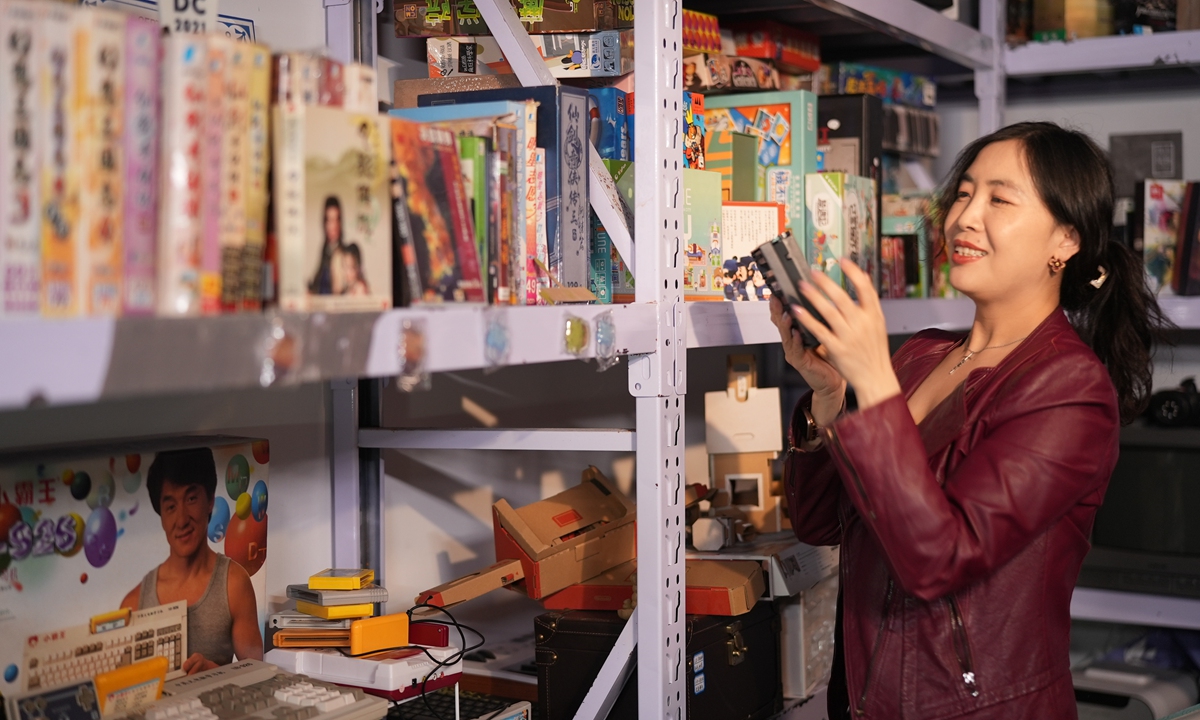
Inside Beijing's Homoludens Archive, shelves are filled with books, game consoles, game cartridges and other materials tracing the history of video games. For Liu Mengfei, the archive's director and chair of the academic committee of the Gamification Professional Committee, these collections preserve more than the evolution of games, they also capture the cultural memories of a generation.
A PhD in history from Tsinghua University, Liu has spent more than a decade studying the social impact of games, the role of games in history and digital humanities. Throughout her career, she has continued to explore the relationship between games and people: Why do humans create games? And how do games shape culture and society?
Books, meanwhile, have been an important gateway through which Liu has come to understand the world of games.
"The real value of a book lies not simply in what it tells you, but in whether it can change the way you understand the world and people," Liu told the Global Times.
Books meet games
In 2007, being an undergraduate history student, Liu wrote her thesis on the links between ancient Celtic religion and modern digital games.
To study original sources such as The Gallic War by Roman author Julius Caesar, she taught herself Latin. As her research extended into modern games, she also began reading the rulebooks of Dungeons & Dragons, a tabletop role-playing game.
"From historical texts to game rulebooks, these reading experiences seemed to belong to completely different worlds, but they gradually led me to realize that games are not simply entertainment products. They also contain history, culture and the relationships between people and society," she said.
Later, Homo Ludens, by Dutch historian Johan Huizinga, further transformed the way she understood games. The book gives a theory that humans are not only Homo sapiens, or "rational beings," but also Homo ludens, or "playing beings," and that games are deeply intertwined with human culture, from language and art to religious rituals and sports.
The book had a profound influence on her. It points out that the foundations of human society — language, civilization, religious rituals, sports and art, are all connected to play and games, because we are Homo ludens, "the playing human."
"The idea prompted me to view games from a broader perspective," Liu said. "Games are not an appendage outside human civilization, but are deeply connected to cultural creation and social life."
"It also showed me that games and game-based thinking could extend into broader fields, including education and technology," she added.
She later read other works on game studies, including Play Between Worlds: Exploring Online Game Culture, Half-Real and Rules of Play Game Design Fundamentals. Play Between Worlds, in particular, opened up another possibility for game studies at a time when discussions about "internet addiction" were prevalent in China.
"Games are not simply a form of entertainment that needs to be restricted or criticize;. they can also serve as important media for storytelling, cultural expression and exploring relationships," she said.
These reading experiences gradually shifted Liu's focus from simply asking "What are games?" to a deeper question: What can games bring to people?
Beyond time and technology
Periodically, Liu still returns to Homo Ludens in her free time, finding new insights from the book as society changes. In the age of artificial intelligence, she has revisited one of its fundamental questions: As AI becomes increasingly capable of handling repetitive tasks and surpasses humans in efficiency, what does it mean to be human?
"As AI takes over more monotonous and repetitive work, the time freed up should be devoted to creativity, experience and human relationships," she said. "The time we gain should actually be used to become better at 'playing humans.'"
For Liu, this also requires people to maintain their ability to think, imagine and reflect -- abilities that cannot be gained through simply receiving information. This has also prompted her to reconsider the meaning of reading.
In an era when AI can quickly summarize an entire book, Liu believes people still need to read the original works in full, because the value of reading lies in more than simply acquiring knowledge and conclusions.
"Reading a book is like a form of cultivation. You have to immerse yourself in it, patiently allow the author to take you on a journey, and find your own island along the way," she said.
For Liu, the value of reading is not limited to books on paper. As media evolve, so do the ways people encounter stories and understand culture. Some digital works are now becoming new vehicles for reading.
Chinese-developed games such as Genshin Impact contain hundreds of thousands, and even more than a million Chinese characters of text, while Black Myth: Wukong uses its "Journal" system to tell the stories of individual monsters through written entries.
"Digital games are carrying forward traditions inherited from literature and film, becoming new gateways, through which young people can enter the worlds of literature, history and traditional culture," she said.
"An important reason why Black Myth: Wukong has succeeded in communicating Chinese culture is that it does not simply insert traditional cultural symbols into a game. Instead, it draws on the original Journey to the West, contemporary works inspired by the classic, as well as the game's own rules and interactions, allowing players to develop a new understanding of traditional culture through their actions," she noted.
For Liu, the forms of reading may change, but the desire to understand the world and discover oneself will not. From books to digital worlds, what matters is not only what people read or play, but how they think, create and find meaning through these experiences.
。 카페인 부작용을 완화할 수 있는 방법을 살펴봤다. /클립아트코리아커피 속 카페인은 각성 효과를 내지만 속 쓰림, 두근거림, 손 떨림, 소변량 증가 등의 부작용이 나타나기도 한다. 카페인에 민감할수록 이런 증상이 더 쉽게 발생한다. 카페인 부작용을 완화하려면 어떻게 해야 할까?물 많이 마시기카페인 섭취 후에는 수분 섭취량을 늘리는 게 좋다. 카페인이 항이뇨호르몬인 바소프레신 작용을 억제해 소변량을 늘리기 때문이다. 클리블랜드 클리닉 공인 영양사 베스 체르보니에 따르면, 카페인 섭취 후 체내 카페인 농도가 절반으로 줄어드는 데는 약 다섯 시간이 걸린다. 그는 “카페인이 대사되는 동안 물을 충분히 마시면 탈수 같은 부작용을 완화하고, 체내 수분 균형을 유지할 수 있다”고 했다. 가볍게 몸 움직이기 커피를 마신 뒤 안절부절 못 하는 증상이 나타났다면 몸을 움직여 보자. 건강 매체 ‘헬스라인(Healthline)’은 가벼운 움직임이 불안감과 초조함을 완화하고, 긴장도를 낮추는 데 도움을 준다고 했다. 스트레칭, 걷기, 가벼운 요가 동작이 좋다. 격렬한 운동은 떨림과 불안감을 악화시킬 수 있으므로 자제한다.단백질 풍부한 간식 먹기공복에 커피를 마시면 카페인이 빠르게 흡수돼 부작용이 심하게 나타난다. 식사 후에 커피를 마시거나, 달걀이나 요거트 등 단백질이 풍부한 간식을 곁들여 먹으면 카페인 흡수 속도를 늦출 수 있다. 사과, 통곡물 크래커처럼 당분이 적고 복합 탄수화물이 들어있는 음식도 도움이 된다. 이런 식품은 카페인 흡수 속도를 조절하면서 혈당 변동을 줄여 불안감을 덜어준다.다른 자극제 피하기건강 매체 ‘헬스(Health)’는 카페인이 함유된 차, 탄산음료, 초콜릿, 약물을 함께 복용하면 안 된다고 했다. 특히 에너지 음료는 1회 제공량당 카페인 함량이 최대 242mg에 달할 수 있어 주의가 필요하다. 커피를 마신 상태로 이런 식품을 먹으면 두근거림 같은 부작용이 악화될 가능성이 있다.섭취 권장량 넘기지 말아야부작용을 줄이는 가장 좋은 방법은 몸 상태에 따라 카페인 섭취량을 조절하는 것이다. 식품의약품안전처는 성인의 카페인 일일 최대 섭취량을 400mg으로 제한한다. 어린이나 청소년은 체중 1kg당 2.5mg이다. 아메리카노 한 잔에는 약 150mg의 카페인이 들어있어, 하루에 두세 잔을 넘기지 않는 게 좋다. 평소 카페인에 민감하다면 이보다 섭취량을 더 줄여야 한다. 커피, 차, 초콜릿 등을 통한 카페인 섭취 총량을 확인하고 이를 조절하려는 노력이 필요하다.。
Current article:http://tngtig.cesangrangshunzashuangruijiu.pics/list_ujo6v5/cpb0v9.html
Published on:09:54:43
 绣春刀
绣春刀 战狼2
战狼2 出租车司机
出租车司机 复仇者联盟2
 赌神
赌神 一米阳光
一米阳光 巨星秀
巨星秀 恶作剧之吻
恶作剧之吻


