如果我爱你
一个降低价格的好方法:索尼保持了微单次发货总量和数量的双冠。_我的网站

一 |
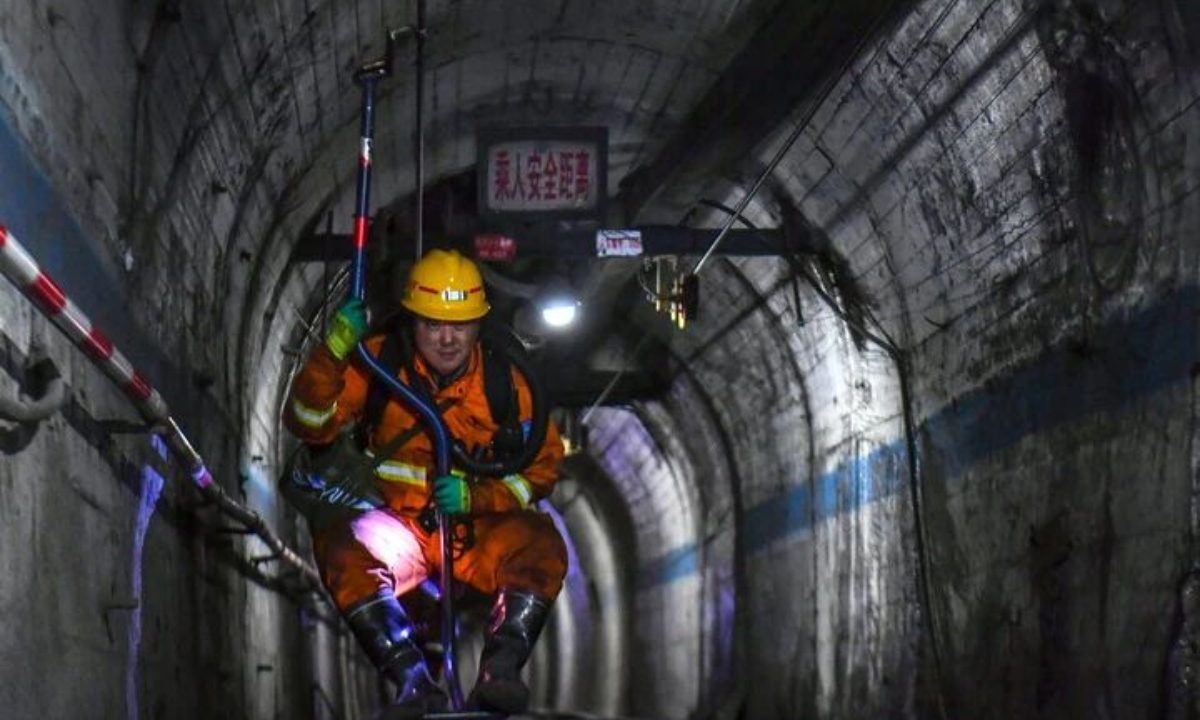
Rescuers emerge from the mine after more than 10 hours of underground search operations at the Liushenyu coal mine in Changzhi, North China's Shanxi Province on May 23, 2026. Photo: Xinhua
China is stepping up the intelligent transformation of its high-risk coal mines, as the country's top economic planner and energy regulator rolled out a new development plan during the 15th Five-Year Plan (2026-30) period that calls for greater use of artificial intelligence (AI) and robots in hazardous underground operations.
The National Development and Reform Commission and the National Energy Administration (NEA) on Monday announced a plan that emphasizes the need to strengthen coal's role as a foundational and balancing pillar in China's energy supply system while accelerating high-quality development in the sector, according to the NEA's website.
According to the plan, China will deepen its "AI Plus" initiative in the coal industry by collecting and integrating AI-related data and expanding the use of AI across key scenarios such as exploration and design, construction and production, operation and maintenance, and safety management.
The plan also calls for faster development of specialized large-language AI models for the coal sector, with breakthroughs needed in intelligent perception, autonomous decision-making and intelligent control. It also emphasizes the need to establish a number of pilot coal mines for the integrated application of AI, and improvements in coal mine safety.
The plan specifically targets intelligent upgrades at disaster-prone mines and those that have experienced major accidents, pushing for robotic substitution at hazardous posts, according to the document.
Industry observers said that the move signals a shift in China's coal mine automation efforts from pilot projects to large-scale deployment. High-risk tasks such as tunneling, inspection, rescue, roof support and blasting are emerging as priority areas for substitution by robots.
Hangzhou-based DEEP Robotics has been focusing on the use of quadruped robots for mine inspections and emergency rescue. In May, the company worked with the Zhejiang Provincial Emergency Management Department and other agencies to unveil its embodied intelligent equipment and conducted a live reconnaissance and rescue drill in a mine tunnel in Changshan, East China's Zhejiang Province, the company told the Global Times on Monday.
Using DEEP Robotics' Lynx M20 wheeled-legged robot as its mobile platform, it innovatively integrates large-language models and an onboard platform, and is equipped with a dual-spectrum pod, 5G module, edge computing unit, and other equipment.
Meanwhile, Lingbao CASBOT has formed a joint venture, to focus on the research and application of embodied intelligence robots for underground mining, according to the Beijing Daily. The company has since become involved in key processes such as rock drilling, blasting charge loading and support installation.
Such AI-powered equipment could significantly improve mine disaster warning and emergency response capabilities, helping mines transition to "less-manned" and "unmanned" operations and reducing human workers' exposure to danger, Lin Boqiang, director of the China Center for Energy Economics Research at Xiamen University, told the Global Times on Monday.
Lin said that robots have a clear advantage in dangerous tasks such as patrol inspections in 50 C deep shafts, gas leak detection, and heavy lifting. "For robots, these are exactly the jobs they should be taking on," he said.
Market research firm Zhiyan Consulting estimated that the market for mining robots grew to 2.85 billion yuan ($42.24 million) in 2025.
。去年8月和9月,尼康和佳能推出了一系列全尺寸微型单相机来挑战索尼。经过几个月的竞争,他们现在有多少市场份额?根据BCN R去年12月的统计数据,索尼通过降低价格维持了其全部的微型单件出货量和数量。

二 | 据BCN R统计,索尼凭借7台全尺寸微型单相机稳获出货量和金额之和,占销量的66.4%,其中出货量最高的A7M3占整个微型单市场的40.8%,超过Z6、Z7和EOS R之和;佳能EOS R下降到17.5%,ST阿泰德显示出放缓的趋势;继11月Z6出货后,尼康的双摄像头策略已取得初步成果,连续两次。12月份,月度市场份额上升至16%,出货量接近佳能,销售额超过佳能。BCN R统计数据来源于三分之二的日本零售渠道,大致反映了日本相机的零售状况。值得注意的是,索尼能够保持在整个市场的第一位。一是依靠多种车型,覆盖中低端市场。最便宜的A7只有72.8万日元,最高的A9价格是3795日元。其次,由于价格下降,A7M3的平均价格为29.8万日元,约为Eos R的96%和Z6的69%,而A7R的价格仅为Z7的75%。眼睛聚焦和GM大师都是假的。是的,这是降低价格的好方法。
Current article:http://tngtig.cesangrangshunzashuangruijiu.pics/fps/20260826/855.html
Published on:22:25:56